Personal thought capture
Record ideas during the day and let agents classify them into tasks, concepts, reminders or decisions.
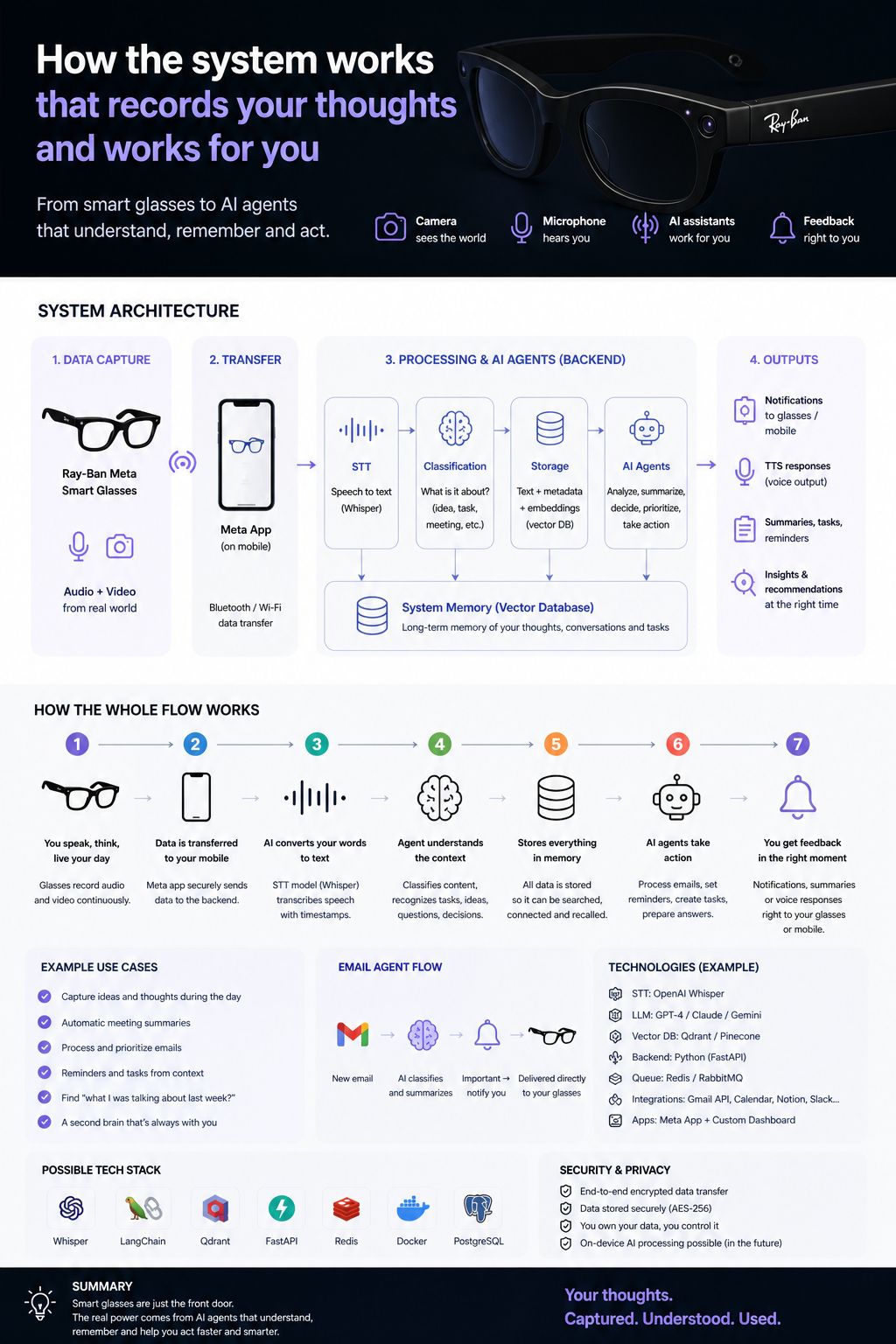
AI Glasses explores how wearable input can capture real-world context and send it into verified AI agents that remember, classify, summarize, prioritize and act.
Definition
The hardware only captures context. The value starts when that context is transferred into an AI backend that can transcribe, classify, store, recall and trigger useful work.
Audio, images and events from real life become structured input for agents.
Thoughts, meetings and context are stored with embeddings for semantic recall.
Agents classify intent, summarize, prioritize, prepare messages and create tasks.
The system returns reminders, summaries and decisions when they are useful.
System architecture
The core idea is simple: glasses collect real-world signals, but backend agents turn them into useful operational output.
Smart glasses capture audio, image context and spoken thoughts.
Mobile app sends selected context to the backend through secure transfer.
STT converts voice to text, classifiers detect intent and metadata.
Text, metadata and embeddings are stored for long-term semantic recall.
Agents generate summaries, reminders, tasks, notifications and answers.
Why it matters
Classic AI waits for a prompt. AI Glasses reverses the flow: context is captured while work happens, and agents decide what should be remembered, summarized or escalated.
Thoughts and events are captured before they are forgotten.
Recall is based on meaning, not folder names or file paths.
The system can convert context into tasks, notes and actions.
Wearables become a practical input layer for verified agent systems.
Example use cases
Record ideas during the day and let agents classify them into tasks, concepts, reminders or decisions.
Capture meeting context, summarize key points and create follow-up actions automatically.
Agents can classify important messages and send the right alert back to glasses or mobile.
Possible stack
Labs can be built as a modular backend where every component has a clear responsibility and can later connect to Veritiana’s verified agent infrastructure.
Security principle
A wearable agent system must treat audio, memory and notifications as sensitive infrastructure. The prototype must be designed around consent, user control, encryption and selective capture.
Labs conclusion
The commercial layer remains Veritiana Answer Engine, Signal and SourceNote. AI Glasses belong in Labs because they prove the future interface: agents connected to real-world context.